
Life in China
China SIM Card for Foreigners: Phone, eSIM and Campus Wi-Fi
How international students get online in China: a SIM card with your passport, eSIM, campus Wi-Fi and its fees, the apps to set up, and the rules to know.
6 min read · Updated 28 Nov 2026 · Verified
In China your phone number does more than make calls. You need it to sign up for WeChat and Alipay, to book appointments and to receive codes from your bank and university. Shanghai Jiao Tong University's 2026 guide for new international students even warns that booking your physical exam may need a Chinese mobile number. So getting online is one of the first things to sort out.

Three ways to get online
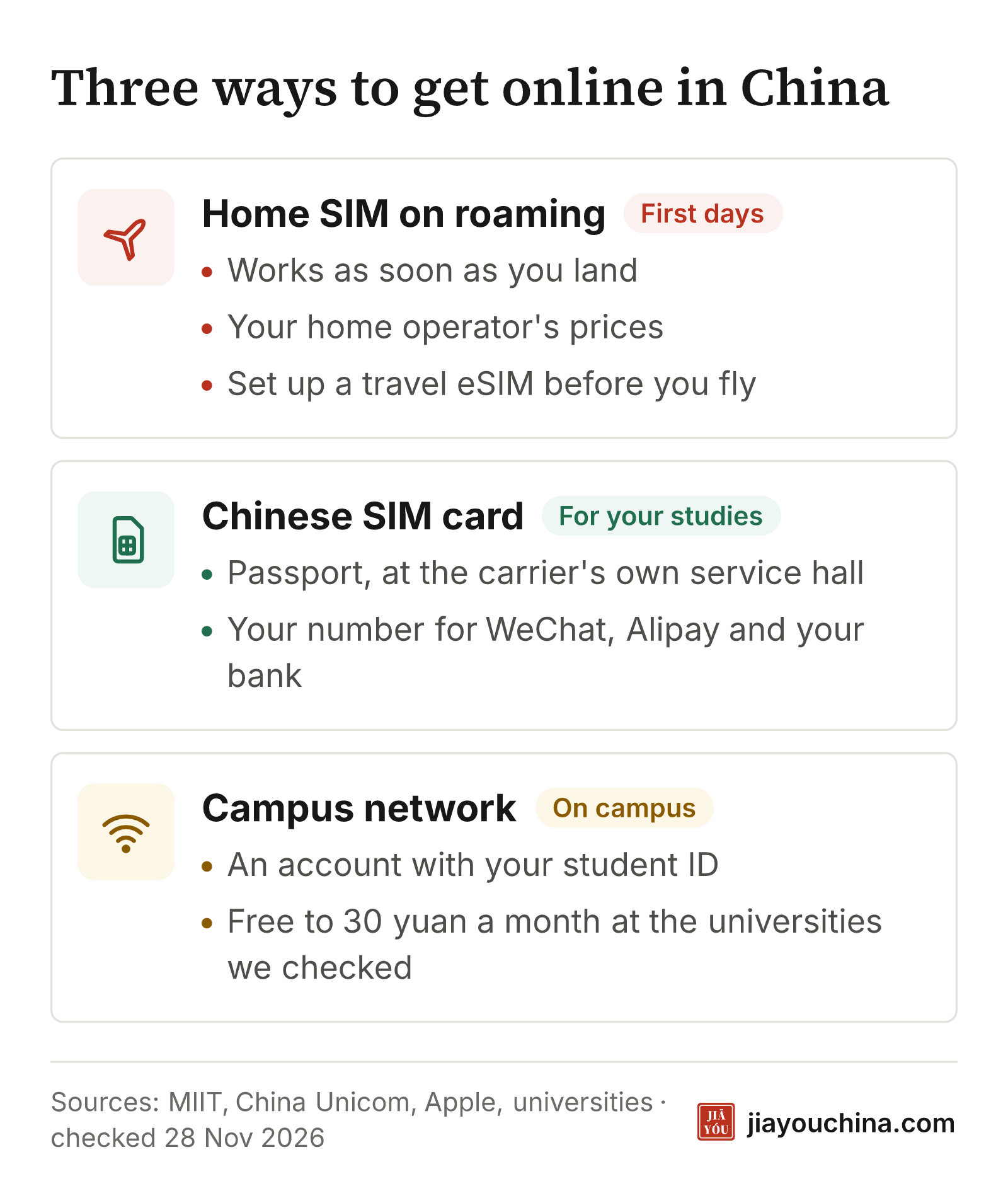
- Your home SIM on international roaming. It works as soon as you land, at your home operator's prices. China's State Council asked carriers in 2024 to give foreign visitors good roaming service and an easier way to get a Chinese number. If you want a travel eSIM from your home country, set it up before you fly: Apple says an eSIM from a carrier outside mainland China can't be installed on an iPhone while you are in mainland China.
- A Chinese SIM card. This is the number you will use for your studies. See the steps below.
- The campus network. Universities give students a Wi-Fi account, often tied to the student ID. See the fees below.
Getting a Chinese SIM card
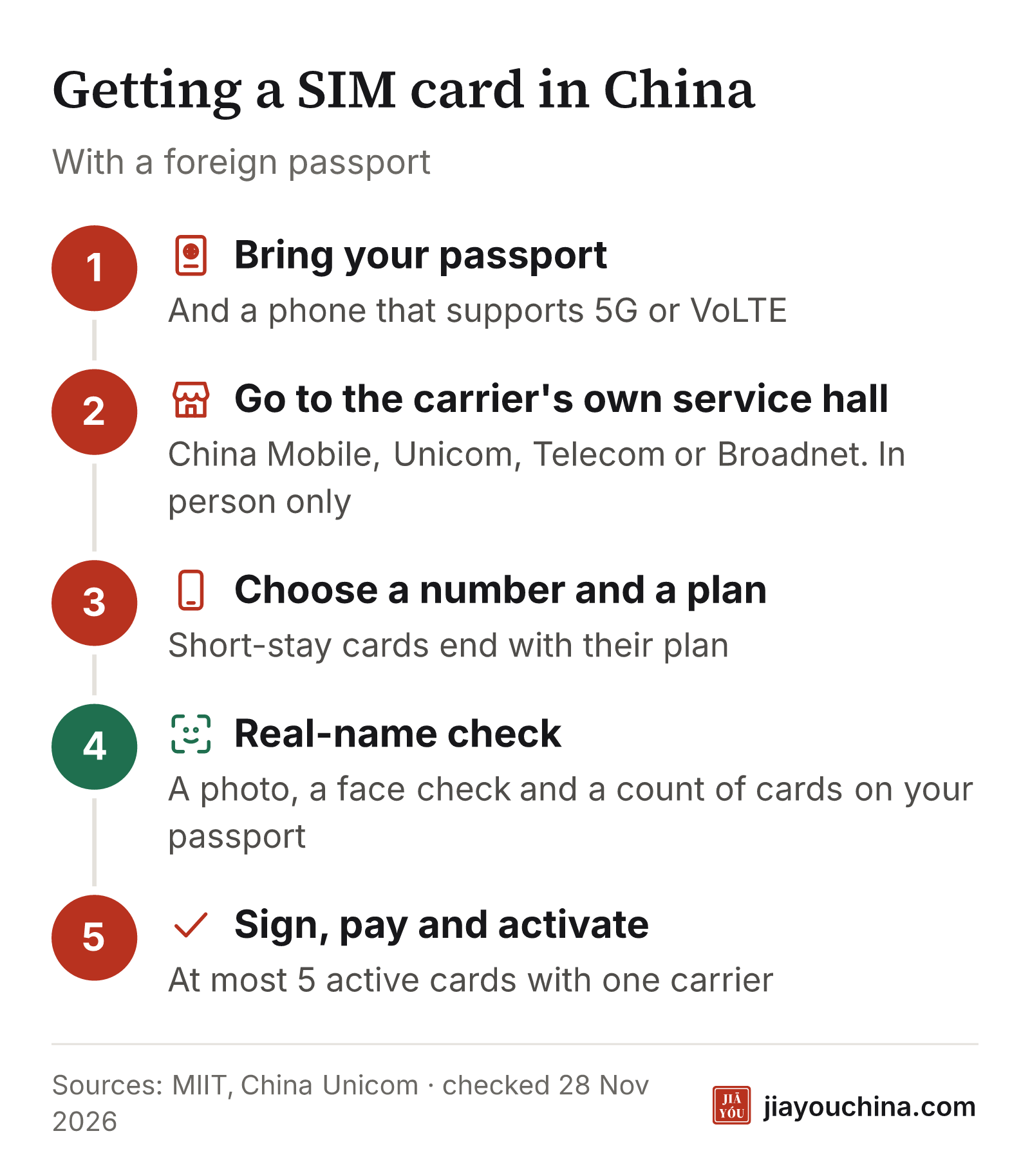
- Where: a service hall run by the carrier itself, called a "self-operated business hall" in the official English. China's telecom regulator (MIIT) says passport holders apply there, in person: nobody can apply for you. The four carriers are China Mobile, China Unicom, China Telecom and China Broadnet.
- What to bring: your passport (or Foreign Permanent Resident ID Card). Your phone must support 5G or VoLTE; if it doesn't fit the card, staff can advise you.
- In the store: you choose a number and a plan, then staff do the real-name registration. At China Unicom this may include a photo on the spot, a face check and a check of how many cards are already registered to your passport. You sign the service agreement, pay and the card is activated.
- How many cards: at most 5 active cards with the same carrier across China. If you hold 10 or more across all carriers, new cards can only be opened at a carrier's own hall.
- At the airport: in Beijing you can apply online and collect your card at the city's service counters: China Mobile at Beijing Capital International Airport and China Unicom at Beijing Daxing International Airport. A 2026 government plan asks carriers to add service points at the busiest entry airports.
- Help in English: China Mobile has an English SIM card guide with a store finder. China Unicom's app has an English version, and you can call 10010 for English customer support. The carriers' hotlines are 10086 (China Mobile), 10010 (China Unicom) and 10000 (China Telecom).
Short-stay cards. China Unicom's Tourism SIM Card for foreign visitors shows its prices on its official page (checked 28 November 2026):
| Price | Valid for | Data in China | Call minutes |
|---|---|---|---|
| 79 yuan | 7 days | 18 GB | 100 |
| 109 yuan | 11 days | 25 GB | 200 |
| 159 yuan | 15 days | 40 GB | 300 |
| 259 yuan | 30 days | 80 GB | 400 |
The number is cancelled when the plan ends, and it can be renewed at most three times, so it suits a short course or your first weeks. For a degree, ask the store for a regular monthly plan: carriers publish their own prices, and we found no official page listing plans for foreign students.
Things to watch:
- China Mobile's English guide notes that your number is deactivated automatically when your plan expires, and that service may be suspended if out-of-plan charges reach 600 yuan. Read the terms of your plan.
- Never sell, rent out or lend your SIM card, or help someone else pass a real-name check. China's Anti-Telecom and Online Fraud Law bans it (Art. 31). The penalty is a fine of one to ten times the illegal gains, or up to 200,000 yuan when there were none or less than 20,000, and up to 15 days' detention in serious cases (Art. 44). Bank and payment accounts fall under the same rule.
- When you leave China for good, cancel your number at the carrier. China Unicom advises this to avoid overdue charges and legal risks.
eSIM
China Mobile announced in October 2025 that it had approval for a commercial trial of eSIM on phones, set up in its stores. Whether you can use one depends on your phone: Apple says only certain iPhone models sold in mainland China work with a mainland carrier's eSIM, and that "other iPhone models, including those purchased outside of China mainland, are unable to install an eSIM profile from carriers in China mainland." If you bring your phone from home, plan on a physical SIM card.
Campus Wi-Fi and dorm internet
Your university gives you a campus network account, usually with your student ID. Fees differ a lot. Examples from universities' own pages:
| University | Campus network |
|---|---|
| Wuhan University | Account ready when you arrive; first week free, then 20 yuan a month |
| Nanjing University | Degree students: first 30 hours a month free, then 0.20 yuan an hour, at most 20 yuan a month. Non-degree students: 30 yuan a month |
| Sichuan University | SCUNET: 90 free hours a month, or 10 yuan a month unlimited. Opening the account is free the first time for degree students |
| Shanghai Jiao Tong University | Wi-Fi with your jAccount; the international student apartments have free campus network |
Ask your international office how yours works. Many universities explain it in the arrival guide they send with your admission letter.
Apps to set up
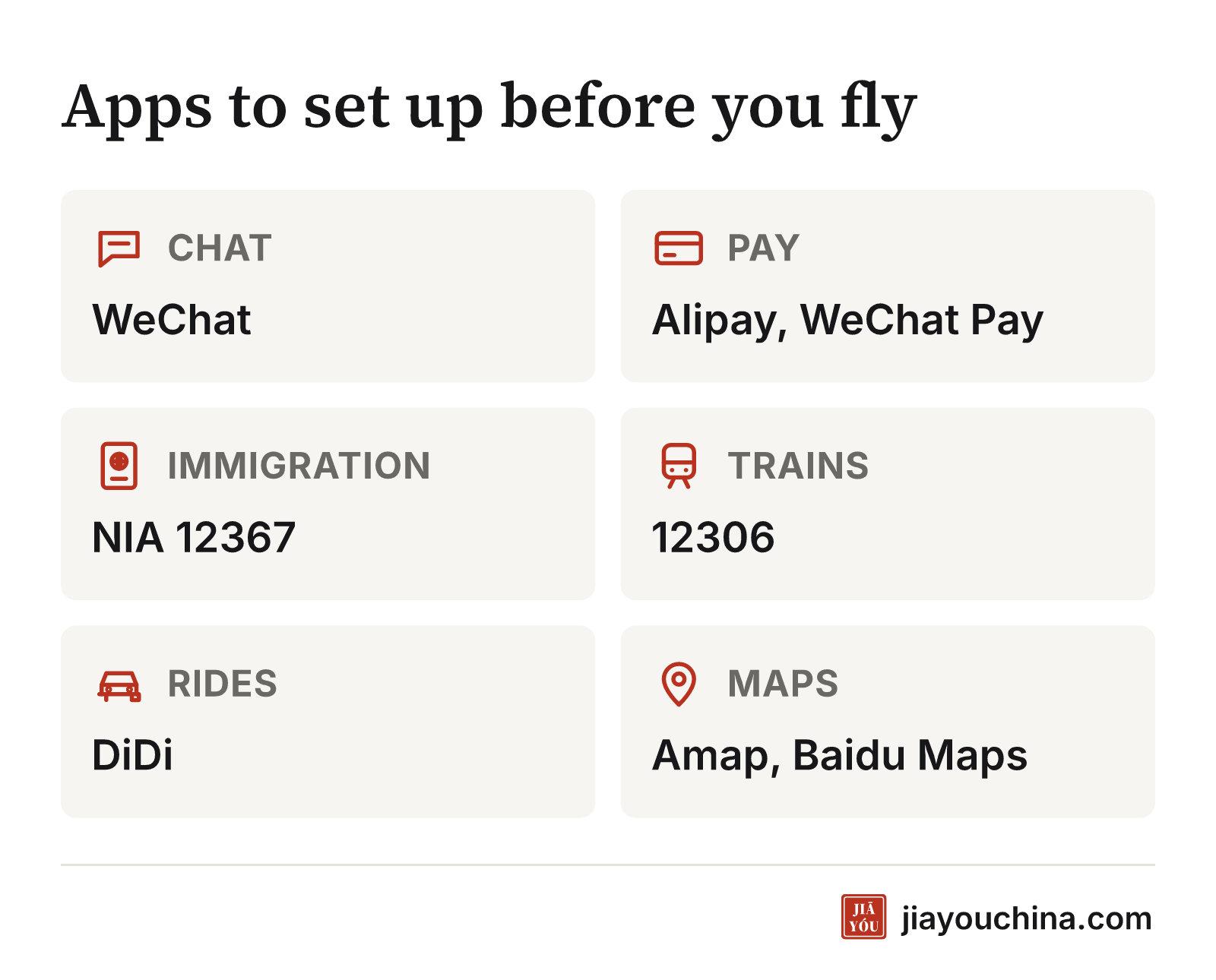
- WeChat: sign up with your country code and mobile number. A WeChat user may need to scan a code to help you, or you can verify with a payment card. Each number can create only one account.
- Alipay and WeChat Pay: both take foreign cards. See Alipay and WeChat Pay for foreigners.
- NIA 12367 (移民局12367), the National Immigration Administration's app: since 21 September 2026 you can register where you live online anywhere in China. See renting an apartment in China.
- 12306, China Railway's official site and app: buy train tickets with your passport; there is an English website.
- DiDi: the government's 2024 guide for foreigners says its app accepts a foreign phone number and bank card. Foreign passengers can also book rides through Alipay and WeChat.
The rules on internet access
China's rules on the international internet apply to everyone in the country, students included:
- International connections must use the gateways of the national public telecom network, and no organisation or individual may set up or use other channels (State Council regulation on international networking, Art. 6). Breaking this can bring an order to stop, a warning and a fine of up to 15,000 yuan (Art. 14).
- Without approval from the telecom authority, nobody may set up or rent dedicated lines, including VPNs, to carry out cross-border business (MIIT notice of 2017).
- International students must obey Chinese laws and regulations and their university's rules (Ministry of Education Order No. 42, Art. 3).
Use the campus network, a Chinese SIM card or your home operator's roaming. Before you fly, download course materials and save the files and contacts you need.
For everything else in your first weeks, see your first 30 days in China and student life in China.
Frequently asked questions
Can a foreigner get a Chinese SIM card?
Yes. Take your passport to a service hall run by the carrier itself (China Mobile, China Unicom, China Telecom or China Broadnet) and apply in person; nobody can apply for you. Your phone must support 5G or VoLTE.
How many SIM cards can a foreigner have in China?
At most 5 active cards with the same carrier across China. If you hold 10 or more across all carriers, new cards can only be opened at a carrier's own service hall.
Can I use an eSIM in China?
Chinese carriers have started offering phone eSIMs in their stores, but only on phones that support them. Apple says iPhones bought outside mainland China cannot install an eSIM from a mainland carrier, so plan on a physical SIM card if you bring your phone from home.
How much does campus Wi-Fi cost?
It depends on the university. Wuhan University charges 20 yuan a month after a free first week, Nanjing University caps degree students at 20 yuan a month, and Sichuan University's unlimited plan is 10 yuan a month. Some dorms, such as Shanghai Jiao Tong's international student apartments, include it free.
Is it legal to use a VPN in China?
China's rules say international connections must go through the national public telecom network, and no organisation or individual may set up or use other channels. Breaking this can bring a warning and a fine of up to 15,000 yuan. International students must obey Chinese law.