
Life in China
Renting an Apartment in China as a Foreigner: Student Guide
Living off campus in China: your university's permission, the lease and deposit rules, and the 24-hour residence registration, now online in the NIA 12367 app.
4 min read · Updated 28 Nov 2026 · Verified
Most international students start in the university's dorm, where the university registers your address for you. Renting a flat gives you more space, but it comes with rules: your university's permission, a proper lease, and a police registration within 24 hours. Here is the order to do things in.

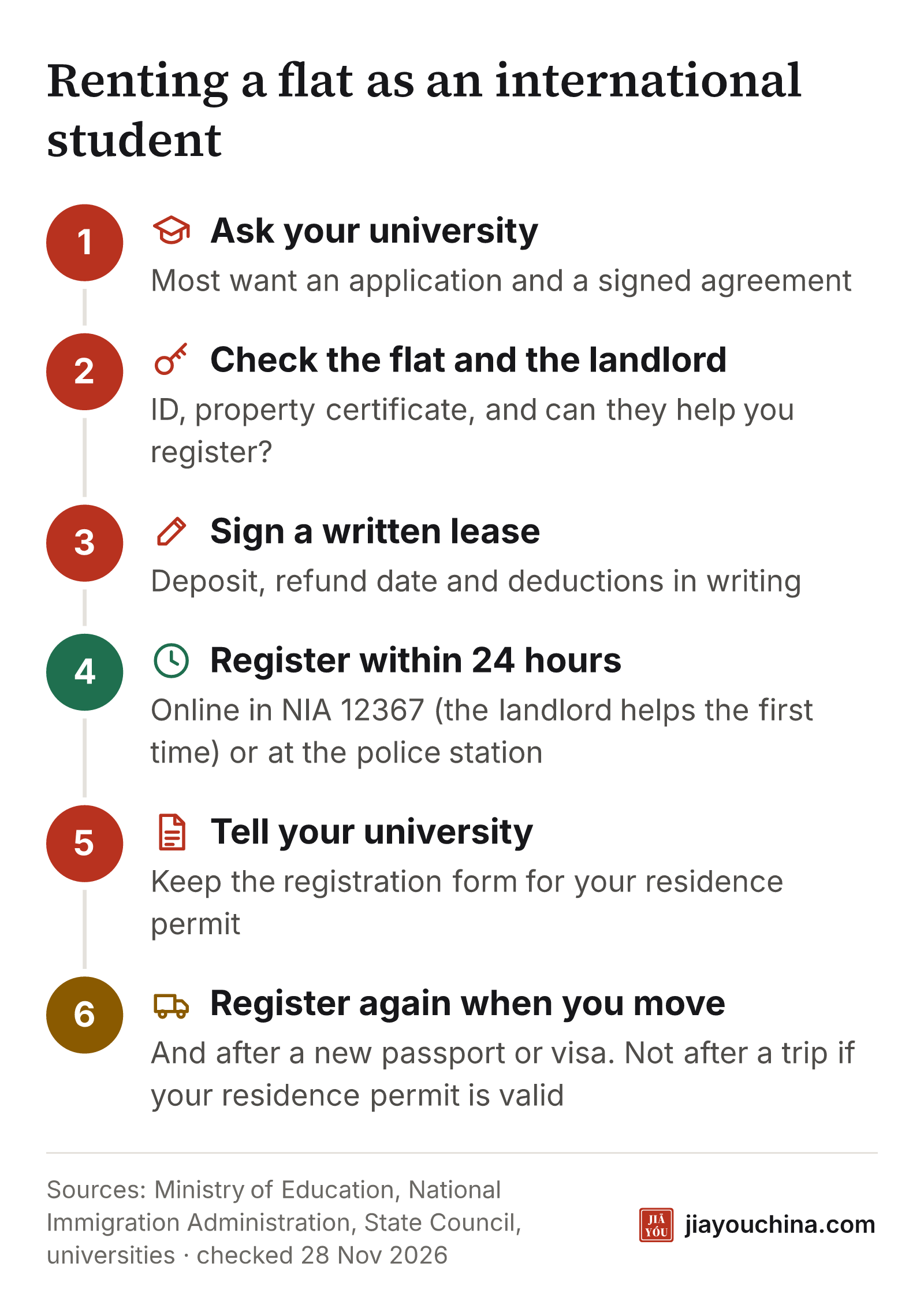
1. Ask your university first
China's rules for international students say that if you live outside the university's dorms, you must register with the local police in time (Ministry of Education Order No. 42, Art. 24). Universities add their own rules. Examples:
- Beijing Forestry University (2026): you apply and sign a commitment letter. You promise to register with the police within 24 hours of moving in and to tell the university when your address changes. Once you are approved, the university takes back your campus bed and can't promise you one if you want to move back.
- South China Normal University: you apply to the international student office and sign its off-campus agreement. Without proof of a legal address, the office won't register you for the semester and the police won't process any visa papers.
- Sichuan University: if your address or phone number changes, tell the Overseas Students Office.
Ask your international office what yours requires before you sign anything.
2. Check the flat and the landlord
- Ask to see the landlord's ID and the property ownership certificate, or another document proving they may rent it out. Under China's Housing Rental Regulations (in force since 15 September 2025), the landlord must show these, and you show your passport (Art. 9 and 11).
- Make sure the landlord can do the police registration with you. Tsinghua and Sichuan University both warn: confirm this before you sign or pay, or you may end up staying illegally.
- Kitchens, bathrooms, balconies, corridors, basement storerooms and garages may not be rented out on their own as a place to live (Art. 7).
3. Sign a written lease
- Sign in your real names (Art. 8). A lease of six months or more must be in writing; otherwise it counts as an open-ended lease, which either side can end with reasonable notice (Civil Code Art. 707 and 730).
- Deposit: the lease must state the amount, when it is returned and what can be deducted, and the landlord can't deduct anything else without good reason (Art. 10). There is no national cap. In Beijing, the city's rules say the deposit is generally no more than one month's rent, and rental companies there may collect at most three months' rent at a time (Beijing Housing Rental Regulations, Art. 14 and 36). In Shanghai, rental companies must hold any deposit above one month's rent in a supervised account (Art. 29).
- The landlord files the lease with the local housing office, free of charge. If the landlord doesn't, you may file it yourself (national regulations, Art. 8).
4. Register within 24 hours of moving in
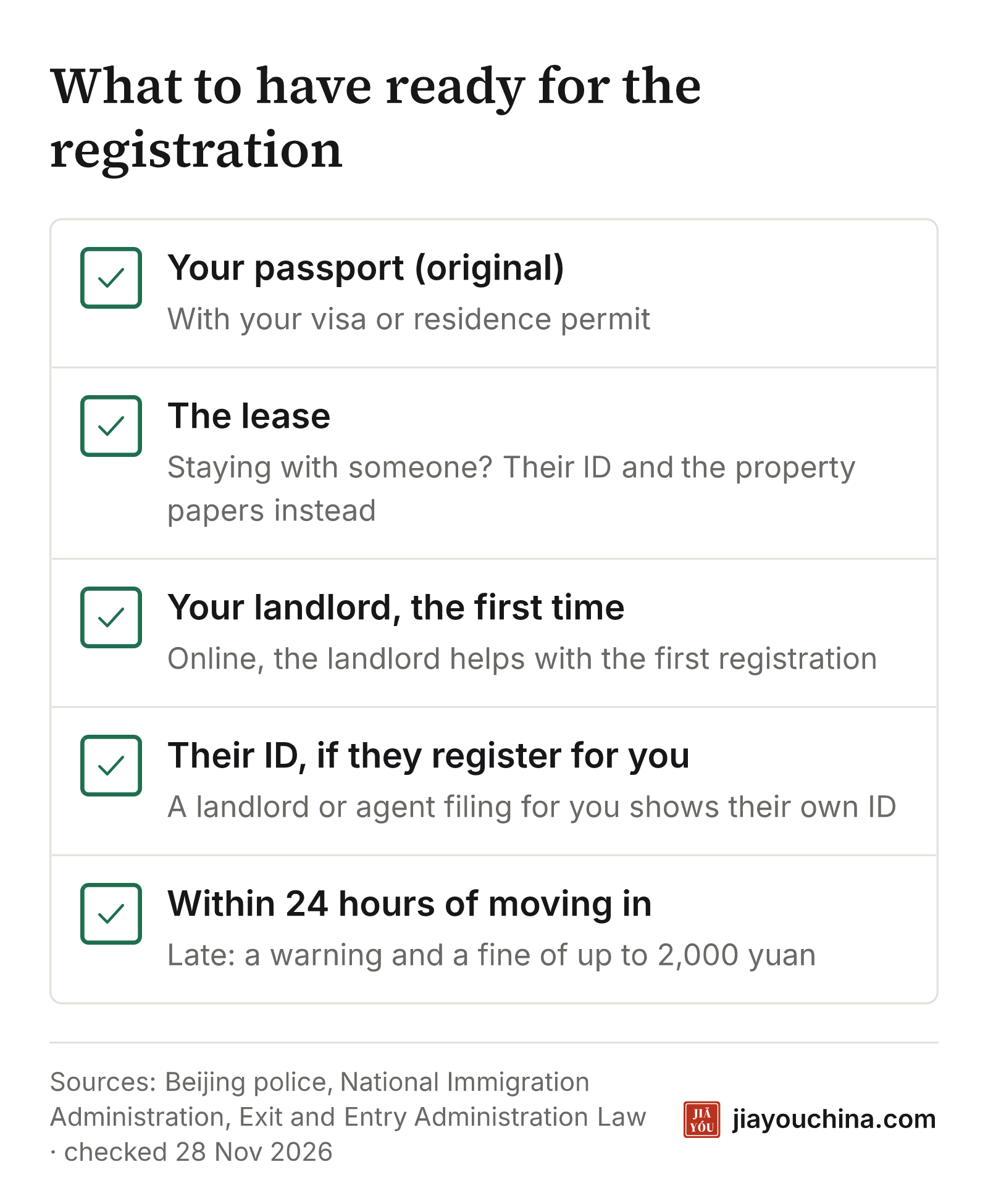
China's Exit and Entry Administration Law says a foreigner living anywhere other than a hotel must register with the local police within 24 hours of moving in, either in person or through the person housing them (Art. 39). Not registering can bring a warning and a fine of up to 2,000 yuan (Art. 76), for you or your landlord.
Online, anywhere in China. Since 21 September 2026 you can register online nationwide, with the same legal effect as at the police station. Use the National Immigration Administration's website (s.nia.gov.cn), the NIA 12367 app (移民局12367), or its WeChat or Alipay mini program, and open the accommodation registration section for foreigners. The first time, your landlord helps you register, because they know the address details. After that you can register yourself for the same address. You can look up your records in the same section.
At the police station. You can still register in person at the local police station or the exit-entry office. Beijing's police list what to bring: your passport (original), the lease, and, if a landlord or agent registers for you, their ID. If you stay in someone else's home, bring the owner's or main tenant's ID and the property papers.
Keep the registration slip (Registration Form of Temporary Residence) with your passport. You need it when you apply for your residence permit, and Sichuan University says also for a new visa, a visa extension or an extra entry. See the residence permit guide.
5. Register again when things change
- When you move: register at the new address. Fudan University asks students to do this within 24 hours of moving.
- New passport or visa: Tsinghua and Sichuan University ask you to update the registration after you change your passport or renew your visa.
- After a trip: if you hold a residence permit and come back to the same home while that permit is valid, you don't need to register again, whether you travelled in China or abroad (National Immigration Administration, 2026).
Not sure? Call the National Immigration Administration's hotline, 12367.
Dorm or flat?
In the dorm, the university handles the registration for you. To compare prices, see what dorm rooms cost in different cities in cost of living in China for students, and each university's fees on our tuition fees page. For everything else about daily life, see student life in China.
Frequently asked questions
Can international students rent an apartment in China?
Yes, but most universities want you to apply first and sign their off-campus agreement. You must then register your address with the police within 24 hours of moving in, and tell your university where you live.
How do I register my address after renting?
Within 24 hours of moving in, register online in the NIA 12367 app, its WeChat or Alipay mini program or the NIA website, which works anywhere in China since 21 September 2026. The first time, your landlord helps you. You can also go to the local police station with your passport and lease.
What happens if I don't register within 24 hours?
China's Exit and Entry Administration Law allows a warning and a fine of up to 2,000 yuan, for you or the person housing you. Your university may also refuse to process your visa or residence permit papers without the registration.
How much deposit can a landlord ask for?
There is no national cap: the lease must state the deposit, when it is returned and what can be deducted. In Beijing, the city's rental rules say the deposit is generally no more than one month's rent.
Do I need to register again after a trip home?
Not if you hold a residence permit and come back to the same home while that permit is still valid. You do need to register again when you move, and many universities also ask you to update it after a new passport or visa.