
Life in China
Alipay and WeChat Pay for Foreigners: Setup, Fees and Limits
How international students pay by phone in China: Alipay and WeChat Pay with a card from home, fees and limits, wallets from home, cash and a Chinese bank card.
4 min read · Updated 28 Nov 2026 · Verified
In China you can pay by phone almost anywhere, from a market stall to a taxi. As a foreigner you can use the same two apps as everyone else, Alipay and WeChat Pay (Weixin Pay), with a card from home. Here is how to set them up, what they cost, and what to do when the phone isn't enough.
Set up before you fly
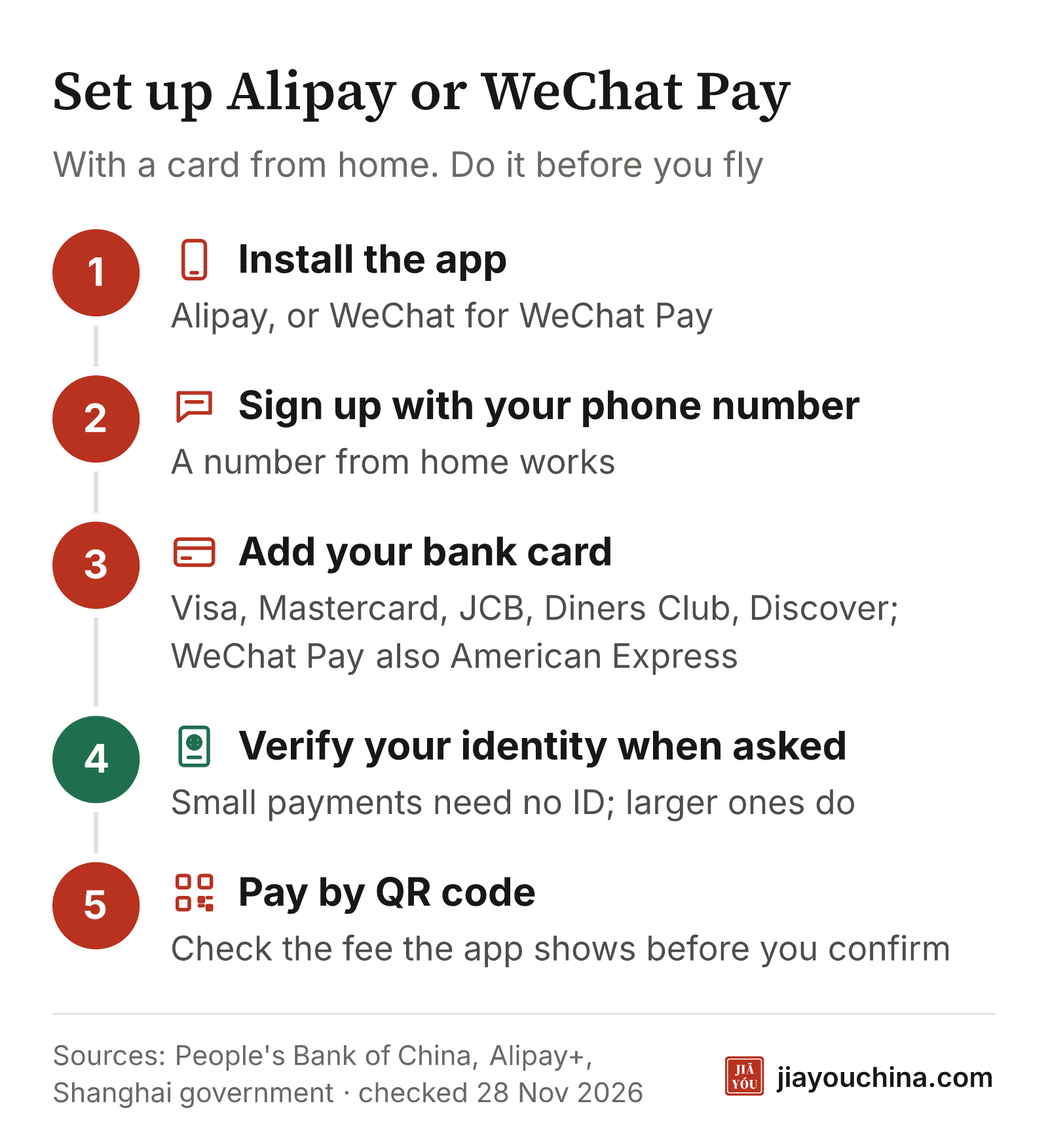
- Install the app. Alipay, or WeChat for WeChat Pay.
- Sign up with your phone number. A number from home works. When you get a Chinese SIM card, you can change the number in the app (Shanghai city government guide). In Alipay, choose the International Version after signing up.
- Add your bank card. Alipay takes Visa, Mastercard, JCB, Diners Club and Discover. WeChat Pay takes the same and American Express (People's Bank of China guide for foreigners). Alipay accepts both credit and debit cards issued abroad.
- Verify your identity when asked. The central bank's guide says no ID is needed for payments under a certain amount; for more, the app asks you to verify who you are, for example with your passport.
- Pay. See the two ways below.
Two ways to pay
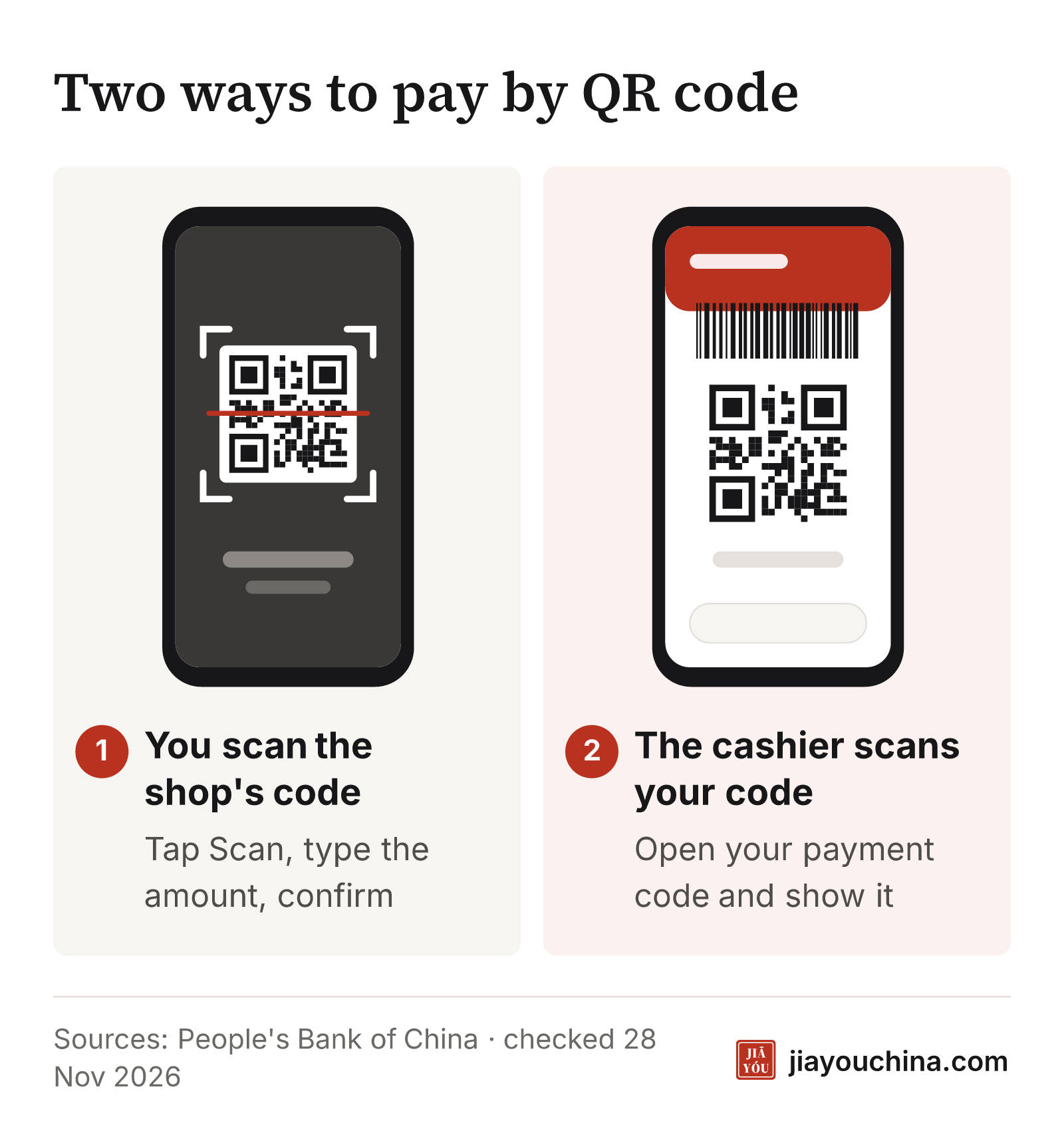
- You scan the shop's code: in Alipay tap "Scan"; in WeChat tap "+" at the top right, then "Scan". Scan the code at the counter, type the amount and confirm.
- The cashier scans yours: in Alipay tap "Pay/Receive"; in WeChat tap "+", then "Money". Show the code on your screen.
Alipay also works for taxis and public transport. In Beijing, Shanghai, Chengdu and other cities, foreigners can ride buses and the metro by scanning a QR code in Alipay or the UnionPay app, with a card from abroad linked.
Fees and limits
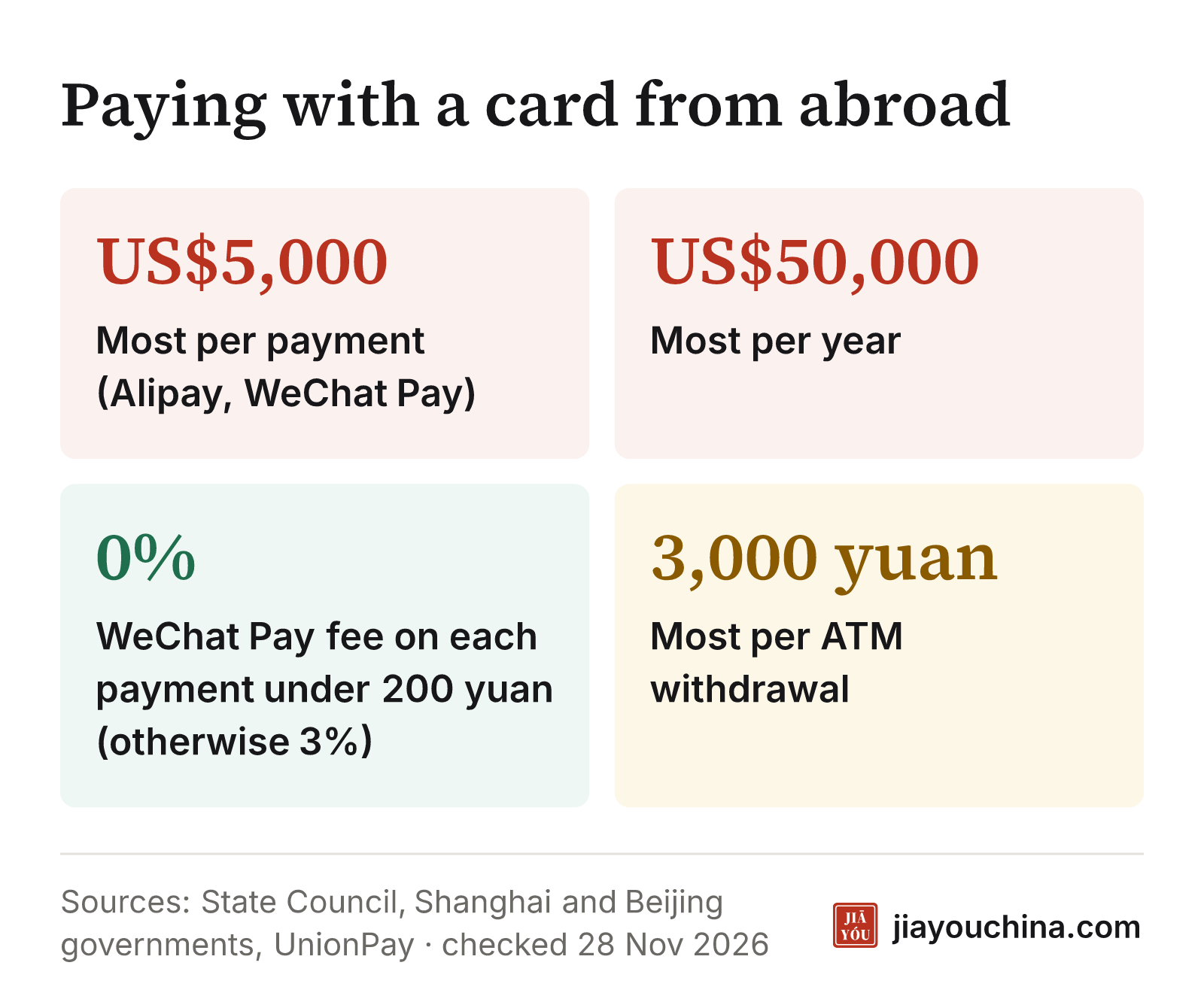
- Limits: with a card from abroad, up to 5,000 US dollars per payment and 50,000 US dollars a year. The State Council raised them from 1,000 and 10,000 dollars in March 2024, and Shanghai's city guide still gives these figures in September 2026.
- Fees: a service fee may apply to payments with a linked card from abroad. The app shows the fee before you confirm, so check it. WeChat Pay waives its 3 percent fee on every payment under 200 yuan (Beijing city government, March 2026).
- Exchange rate: set by the card network and your bank, which may also charge its own fee for payments abroad. Ask your bank before you go.
- What a foreign card can't do on Alipay: transfers to other people, sending or receiving red packets (hongbao), wealth management and insurance. To split a bill with classmates, you need a Chinese bank card (see below).
Paying with a wallet from home
Some wallets from home work at Chinese shops directly, without installing Alipay: you scan the shop's Alipay code from your own wallet app. Alipay+ lists these for mainland China (checked 28 November 2026):
| Country or region | Wallets |
|---|---|
| Malaysia | Touch 'n Go eWallet |
| Thailand | TrueMoney, K PLUS, SCB Planet Plus |
| Philippines | GCash, HelloMoney |
| Kazakhstan | Kaspi.kz |
| Pakistan | NayaPay |
| South Korea | Kakao Pay, NAVER Pay, Toss Pay |
| Mongolia | Hipay |
| Singapore | OCBC |
| Hong Kong, Macao | AlipayHK, MPay |
Alipay+ says it charges no extra fee, but your wallet may ask for identity checks or set its own limits. The list for mainland China shows no wallet from Indonesia or Vietnam. UnionPay adds that some wallets can also pay Weixin Pay codes, including K PLUS and Bangkok Bank's app in Thailand and ICBC Pay in Malaysia.
Cash and bank cards
- Cash must be accepted. Under the central bank's rules in force since 1 February 2026, no one may refuse cash at a staffed checkout or for a face-to-face service. Places that use a campus card (一卡通), schools included, must offer a way to pay or top up in cash, with no fee. You can report a refusal to the local branch of the People's Bank of China. Carry some cash, especially in your first days.
- ATMs: every ATM in mainland China takes UnionPay cards. With a card issued abroad you can take out at most 3,000 yuan per withdrawal, and some ATMs set lower limits.
- A Chinese bank account: you can open one with your passport at a bank branch. Shanghai's city guide adds that banks need a Chinese mobile number registered in your real name, and some ask for more, such as proof of address. Link the card to Alipay or WeChat Pay for transfers and red packets. Get a Chinese SIM card first: see China SIM card for foreigners.
- Never lend, rent out or sell your bank card, payment account or phone card. China's Anti-Telecom and Online Fraud Law bans it (Art. 31), with fines and, in serious cases, detention.
For your first weeks, see your first 30 days in China, and for what things cost, cost of living in China for students.
Frequently asked questions
Can foreigners use Alipay and WeChat Pay?
Yes. Both let you sign up with a phone number from home and add a card issued abroad. Alipay takes Visa, Mastercard, JCB, Diners Club and Discover; WeChat Pay also takes American Express.
How much is the fee for paying with a foreign card?
A fee may apply, and the app shows it before you confirm. WeChat Pay waives its 3 percent fee on every payment under 200 yuan. Your own bank may also charge for payments abroad.
What is the spending limit for foreigners?
With a card from abroad linked to Alipay or WeChat Pay, up to 5,000 US dollars per payment and 50,000 US dollars a year.
Can I send money to friends with a foreign card?
Not on Alipay: a card from abroad can't be used for transfers between people, red packets or financial products. For those, open a Chinese bank account and link its card.
Do shops in China still take cash?
Yes. Since 1 February 2026 the rules say no one may refuse cash at a staffed checkout or for a face-to-face service, and campus card systems must offer a way to pay in cash.