
Life in China
Cost of Living in China for Students: Monthly Costs by City
What living in China costs an international student: universities' own monthly estimates, dorm prices, canteen meals, metro fares and price levels in 11 cities.
5 min read · Updated 28 Nov 2026 · Verified
How much money you need each month depends mostly on two things: where you live and whether you live in the dorm. Here is what Chinese universities themselves estimate, what a dorm room, a canteen meal and a metro ride cost, and how prices compare between cities. All amounts are in Chinese yuan (CNY) unless marked, checked on 28 November 2026.

What universities say it costs
Some universities publish their own estimate of living costs for international students:
| University (city) | Its estimate |
|---|---|
| Wuhan University (Wuhan) | Living expenses at least 1,500 yuan a month (admission document from 2023) |
| Xiamen University (Xiamen) | Meals 1,000–1,500 yuan a month; a room in an apartment near the Siming campus about 2,500 yuan a month |
| Xi'an Jiaotong University (Xi'an) | Canteens 150–250 US dollars a month; a shared apartment off campus 200–350 US dollars a month (2025) |
| Sichuan University (Chengdu) | About 5,000 yuan a month, housing, food and transport included (2024) |
| Fudan University, School of Economics (Shanghai) | A dining-hall meal 8–20 yuan; a bus ride 2 yuan; a metro ride 3–8 yuan |
| Shanghai Jiao Tong University, Tsung-Dao Lee Institute (Shanghai) | 6,500 yuan a month, including 3,500 yuan rent off campus and 1,800 yuan for food (2026 programme page) |
| Peking University (Beijing) | Reference costs a year: accommodation about 35,000 yuan, food about 15,000 yuan, other costs including transport about 5,000 yuan |
Much of the difference is rent: Shanghai Jiao Tong's 6,500 yuan includes 3,500 yuan for a flat off campus. The estimates were made in different years and for different students, so use them as a range.
Everyday prices
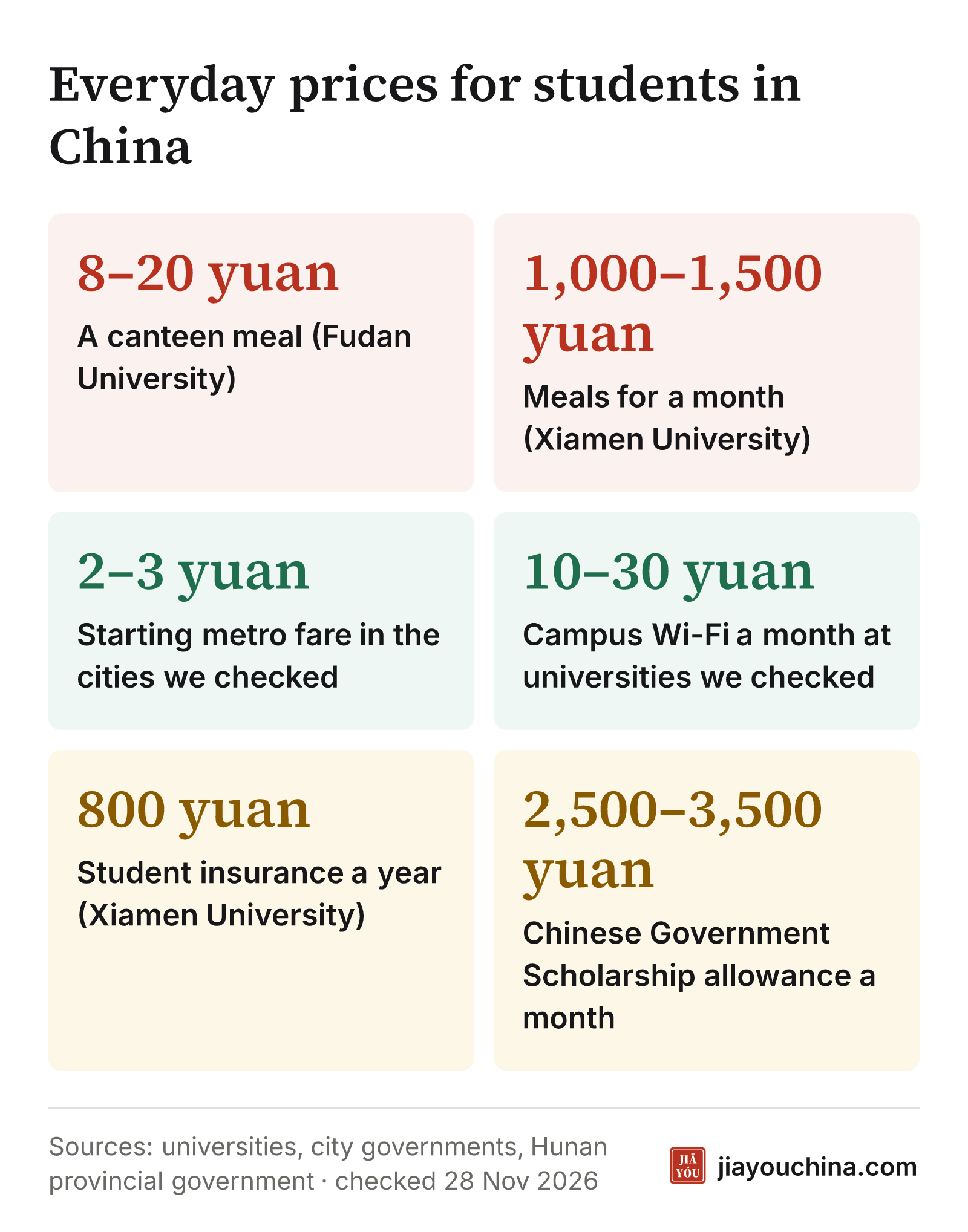
A budget with the Chinese Government Scholarship. The scholarship pays a monthly allowance of 2,500 yuan for bachelor's students, 3,000 yuan for master's students and 3,500 yuan for PhD students. If you live in the dorm, that is a fair guide to what food, transport and a phone cost each month. See the scholarship and scholarships compared.
Dorm rooms by city
Dorms are priced by the day, month, semester or year. The cheapest room at some of the universities whose fees we have checked, as each university publishes it:
Better rooms cost more. Every university's fees, with a link to its official page, are on our tuition fees page. Living off campus? See renting an apartment in China.
How cities compare
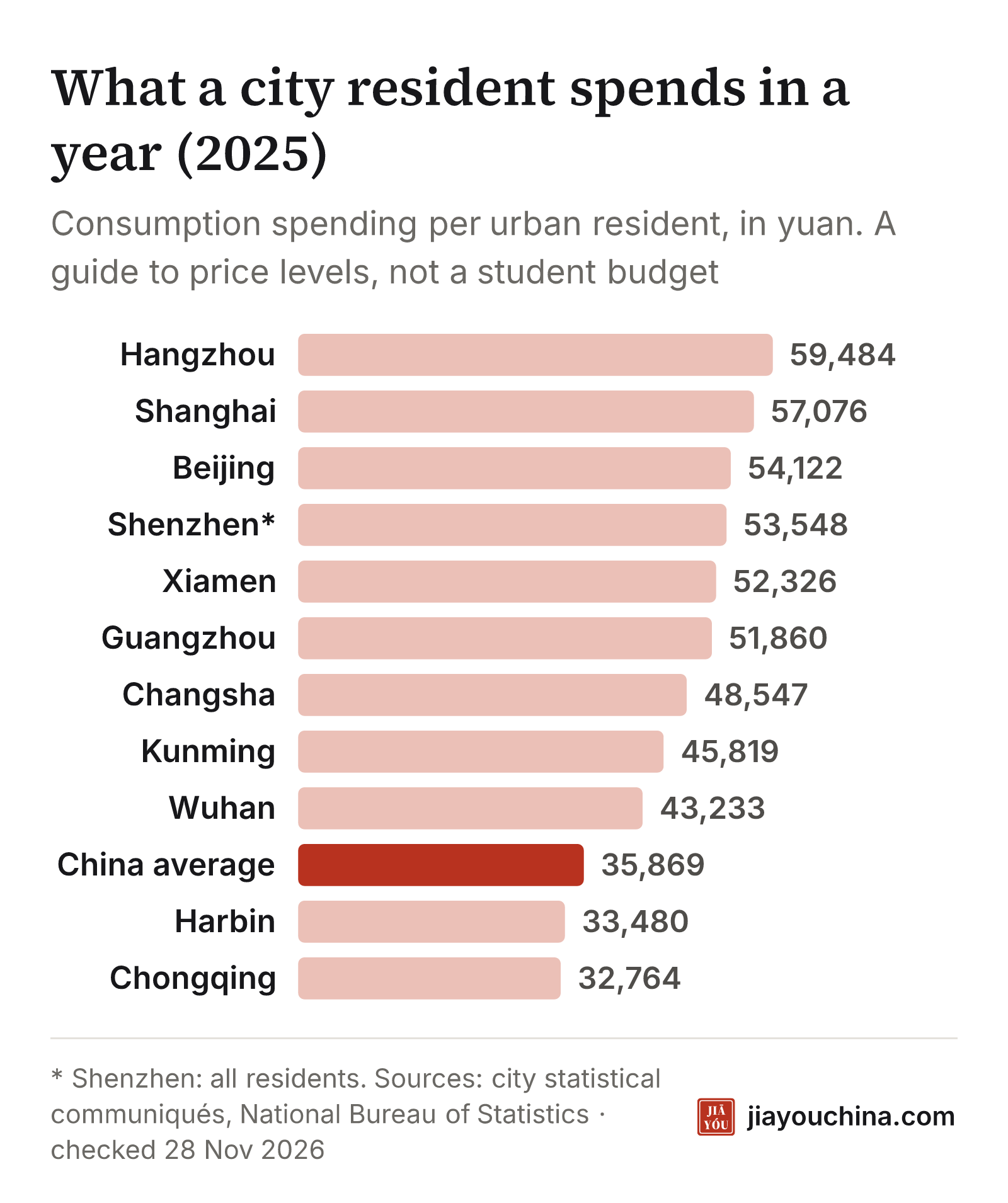
Cities publish how much an average urban resident spends in a year on food, housing, transport and everything else. It is not a student budget, but it shows how price levels differ. In 2025, an urban resident spent 35,869 yuan on average across China; in Shanghai it was 57,076 yuan, in Chongqing 32,764 yuan. Shenzhen publishes one figure for all its residents, which we show instead. We could not read the figures for Nanjing, Chengdu, Xi'an and Tianjin on their official sites.
Getting around
Metro fares go by distance. The starting fare in the cities we checked:
| City | Starting fare |
|---|---|
| Beijing | 3 yuan for up to 6 km |
| Shanghai | 3 yuan for up to 6 km; from 1 December 2026, for up to 4 km |
| Guangzhou | 2 yuan for up to 4 km |
| Shenzhen | 2 yuan for the first 4 km |
| Wuhan | 2 yuan for up to 4 km |
| Chengdu | 2 yuan |
| Xi'an | 2 yuan for the first 6 km |
| Harbin | 2 yuan for 6 km |
| Kunming | 2 yuan for up to 4 km |
- Monthly discounts: in Beijing, after you spend 100 yuan in a month the next rides are 20% off, and after 150 yuan 50% off. In Shanghai, from 1 December 2026, rides are 10% off once you have spent 90 yuan in a month. Wuhan gives a reward for monthly spending on its metro card.
- No student fare for university students appears on the official fare pages we read: the student discounts we found in Shenzhen and Guangzhou are for school pupils.
- Pay by QR code in Alipay or with a transport card: see Alipay and WeChat Pay for foreigners.
Ways to spend less
- Live in the dorm and eat in the canteens.
- Use the campus network instead of a big mobile data plan: some universities charge 10–30 yuan a month, and some dorms include it free. See China SIM card and campus Wi-Fi.
- Think about the city. The same scholarship allowance goes further where prices are lower.
- Apply for scholarships. For tuition, insurance and the first-year budget, see how much money you need to study in China.
Frequently asked questions
How much does it cost to live in China per month as a student?
Universities' own estimates range from at least 1,500 yuan a month (Wuhan University) to about 5,000 yuan in Chengdu with housing (Sichuan University) and 6,500 yuan in Shanghai with off-campus rent (Shanghai Jiao Tong University's Tsung-Dao Lee Institute). If you live in a dorm, the Chinese Government Scholarship's allowance of 2,500 to 3,500 yuan a month is a fair guide for food, transport and phone.
Which cities in China are cheapest to live in?
Of the 11 cities we checked, Chongqing and Harbin had the lowest spending per urban resident in 2025, 32,764 and 33,480 yuan a year, against 57,076 yuan in Shanghai and 59,484 yuan in Hangzhou.
How much is a meal in a Chinese university canteen?
Fudan University's School of Economics says a meal in its dining halls costs 8 to 20 yuan. Xiamen University puts meals at 1,000 to 1,500 yuan a month.
How much does the metro cost in China?
A ride starts at 2 yuan in Guangzhou, Shenzhen, Wuhan, Chengdu, Xi'an, Harbin and Kunming, and at 3 yuan in Beijing and Shanghai; longer trips cost more. Beijing and Shanghai also give discounts once you spend a set amount in a month.
How much is a dorm room in China?
It depends on the university and the room. The cheapest rooms we have checked range from 12 yuan a day (Southwest Jiaotong University in Chengdu) to 16,000 yuan a year (Minzu University of China in Beijing). Each university's page on our site lists its fees with the official source.