
Life in China
Is a VPN Legal in China? What International Students Should Know
Is a VPN legal in China for foreign students? What Chinese rules say, the penalties, how a university VPN differs, and the legal ways to stay connected with home.
3 min read · Updated 28 Nov 2026 · Verified
Before they come, many students ask the same question: will I still be able to use Instagram, WhatsApp, Google or YouTube in China, and is a VPN legal? Here is what China's rules say, what they mean for you as an international student, and the legal ways to stay connected with home.

What Chinese rules say
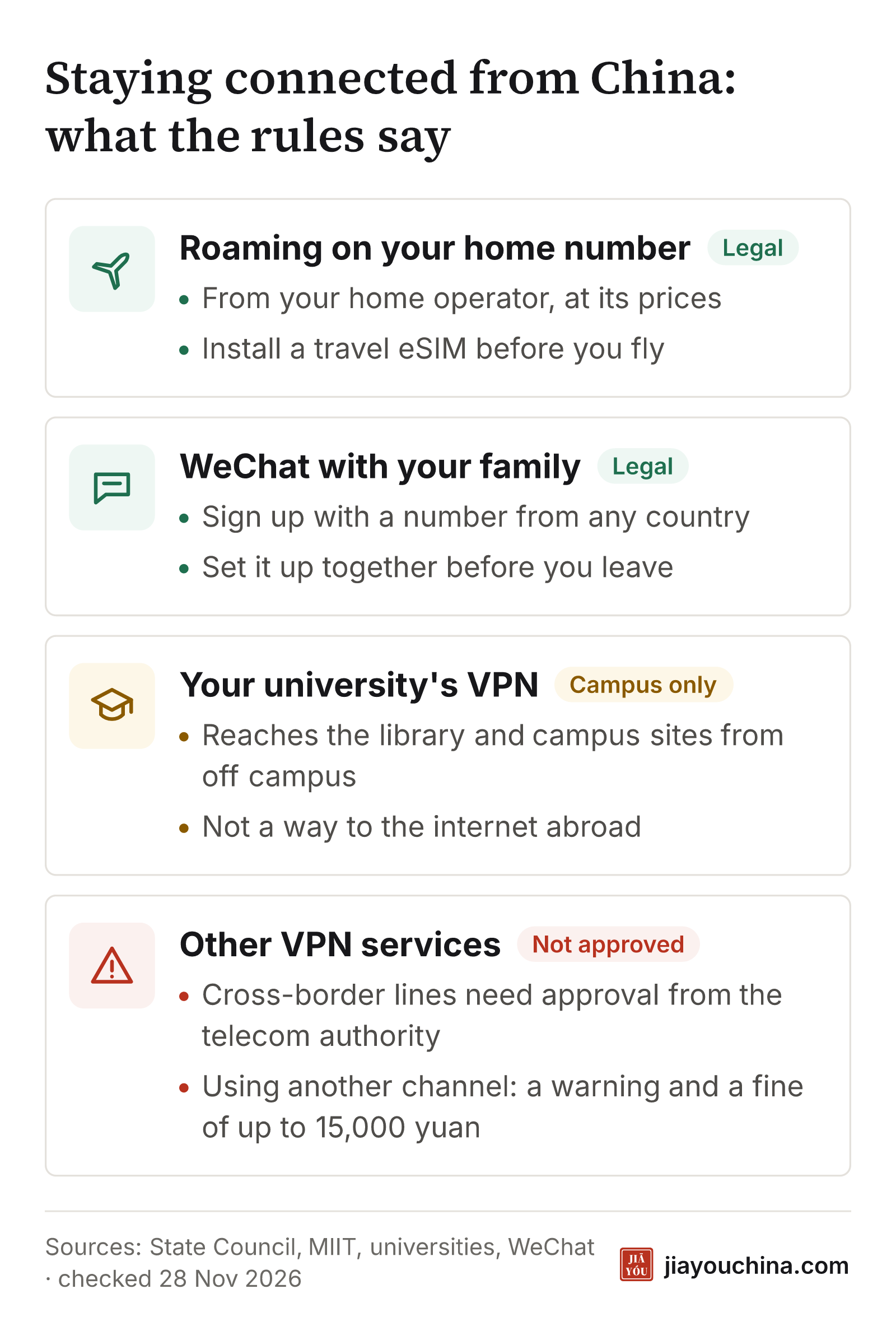
- International connections must go through the national public telecom network, and no organisation or individual may set up or use other channels to connect to the internet abroad (State Council regulation on international networking, Art. 6, amended in 2024).
- Users connect to the international internet through an access network (Art. 10), and the units that run access networks need a licence or approval (Art. 8).
- Breaking Art. 6 or 10 can bring an order to stop the connection, a warning and a fine of up to 15,000 yuan, and any illegal gains are taken (Art. 14).
- Without approval from the telecom authority, nobody may set up or rent dedicated lines, including VPNs, to carry out cross-border business (MIIT notice of 2017). MIIT explained that this notice is aimed at companies and individuals that run cross-border telecom business without a licence, and that companies needing a cross-border line for their own offices can rent one from a licensed carrier.
What this means for you
- There is no exception for foreigners or students in these rules. China's rules for international students also say that you must obey Chinese laws and regulations and your university's rules, and universities must teach you about them (Ministry of Education Order No. 42, Art. 3 and 25).
- Using a VPN service that has not been approved is a risk you take on yourself. We don't list or recommend VPN services: we found no official source on any of them, and using one without approval breaks the rules above.
The VPN at your university is something else
Chinese universities run their own campus VPN. It lets students and staff reach campus-only resources, such as the library's e-resources, from outside the campus, using your campus account:
- Hohai University asks students off campus to use its VPN (vpn.hhu.edu.cn) or the Xuexitong app for the library's online resources.
- Beijing Forestry University explains that its VPN is for reaching campus-only websites from off campus, so it doesn't recommend using the VPN while you are on the campus network.
A campus VPN connects you to your university, not to the internet abroad.
Legal ways to stay connected with home
- International roaming on your home number. It is provided by your home operator at its prices, and China's State Council asked carriers in 2024 to give foreign visitors good roaming service. Ask your operator what its plan for mainland China includes. If you want a travel eSIM from home, install it before you fly: Apple says an eSIM from a carrier outside mainland China can't be installed on an iPhone while you are in mainland China.
- WeChat for calls and messages. Your family can sign up with a phone number from any country. A WeChat user may need to scan a code to help a new account, so set it up together before you leave.
- A Chinese SIM card and the campus network for daily life in China. See China SIM card for foreigners.
- Before you fly, download your course materials and save the files, photos and contacts you need.
For the other rules that apply to you in China, see China's rules for international students, and for your first weeks, your first 30 days in China.
Frequently asked questions
Is a VPN legal in China for foreigners?
China's rules make no exception for foreigners. International internet connections must go through the national public telecom network, and no organisation or individual may set up or use other channels. Breaking this can bring an order to stop, a warning and a fine of up to 15,000 yuan. A VPN used for cross-border connections needs approval from the telecom authority.
Can I use Instagram, WhatsApp or Google in China?
Many students ask this. The legal way to keep using your services from home is your home operator's international roaming, which China's State Council asked carriers to support for foreign visitors: ask your operator what its plan for mainland China includes. A VPN without approval breaks the rules above.
What is my university's VPN for?
It lets students and staff reach campus-only resources, such as the library's e-resources, from outside the campus. Hohai University and Beijing Forestry University, for example, run one with your campus account. It is not a way to connect to the internet abroad.
How do I stay in touch with my family from China?
Ask your family to install WeChat, which you can sign up for with a phone number from any country, and keep your home number on roaming for the first days. Set both up before you fly.